
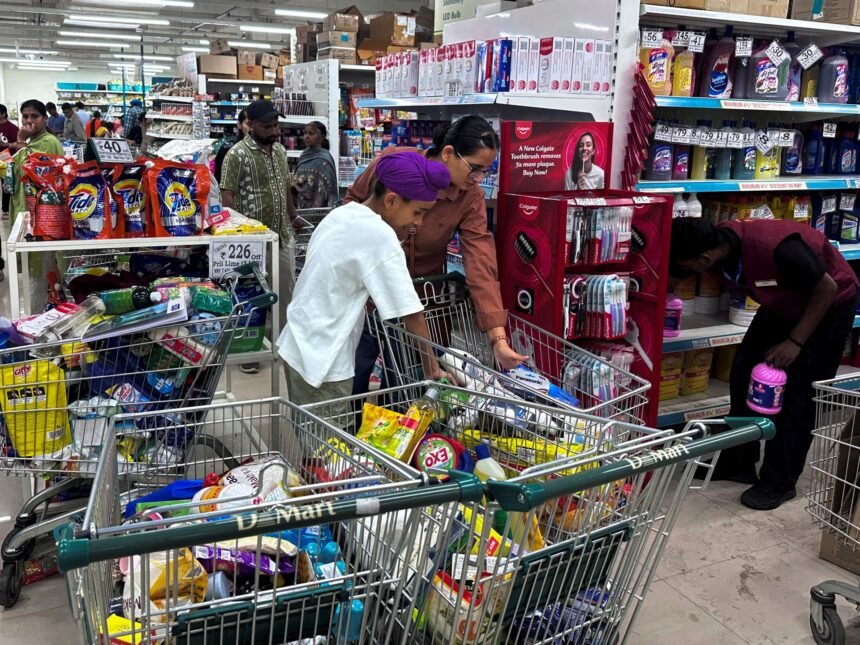
Analysts say the cuts within the Items and Providers Tax is aimed toward boosting demand within the wake of fifty p.c tariffs on Indian items.
Revealed On 3 Sep 2025
India has introduced tax cuts on tons of of shopper objects starting from soaps to small vehicles to spur home demand within the face of financial headwinds from punishing tariffs imposed by US President Donald Trump.
The measures come because the 50 p.c US tariffs took impact final month, elevating fears of an financial slowdown.
The Items and Providers Tax (GST) has been overhauled to simplify India’s advanced four-tier system into two slabs and minimize levies throughout sectors, in some circumstances by greater than half, introduced Finance Minister Nirmala Sitharaman.
Sitharaman stated a panel, which appeared into the GST reforms, authorized cuts in shopper objects akin to toothpaste and shampoo to five p.c from 18 p.c, and on small vehicles, air conditioners, and televisions to 18 p.c from 28 p.c.
The panel, which is headed by Sitharaman, authorized the two-rate construction of 5 p.c and 18 p.c, as an alternative of the 4 charges at the moment.
The brand new tax regime makes insurance coverage premiums, together with life and well being protection, tax-free.
The finance minister insisted the GST cuts weren’t linked to the “tariff turmoil”, saying they had been a part of long-planned reforms.
Federal and state governments are estimated to lose 480 billion Indian rupees ($5.49bn) because of the cuts that might be applied from September 22, the primary day of the Hindu pageant of Navratri.

40 p.c tax on ‘tremendous luxurious and ‘sin’ items
Coupled with cuts in private tax unveiled in February, the GST reductions are anticipated to spice up consumption within the South Asian nation, whose financial system grew at an unexpectedly increased tempo of seven.8 p.c within the quarter to June.
“The consumption increase in lieu of the GST charge rationalisation will greater than neutralise any attainable income impression,” stated Soumya Kanti Ghosh, chief economist at SBI.
“The impression on fiscal deficit might be virtually insignificant and even optimistic.”
The panel authorized a tax of 40 p.c on “tremendous luxurious” and “sin” items akin to cigarettes, vehicles with engine capability exceeding 1,500 cubic centimetres (91.5cu inches), and carbonated drinks, the minister stated.
The transfer is predicted to spice up gross sales of fast-moving shopper items companies akin to Hindustan Unilever and Godrej Industries, and shopper electronics firms akin to Samsung Electronics, LG Electronics, and Sony.
Carmakers akin to Maruti, Toyota Motor, and Suzuki Motor are anticipated to be huge winners. The frenzy to chop the tax was triggered by Prime Minister Narendra Modi’s name for higher self-reliance in India, pledging final month to decrease the GST by October to counter the US tariffs of as much as 50 p.c.
After the tax cuts introduced on Wednesday, Modi stated, “The wide-ranging reforms will enhance lives of our residents and guarantee ease of doing enterprise for all, particularly small merchants and companies.”