
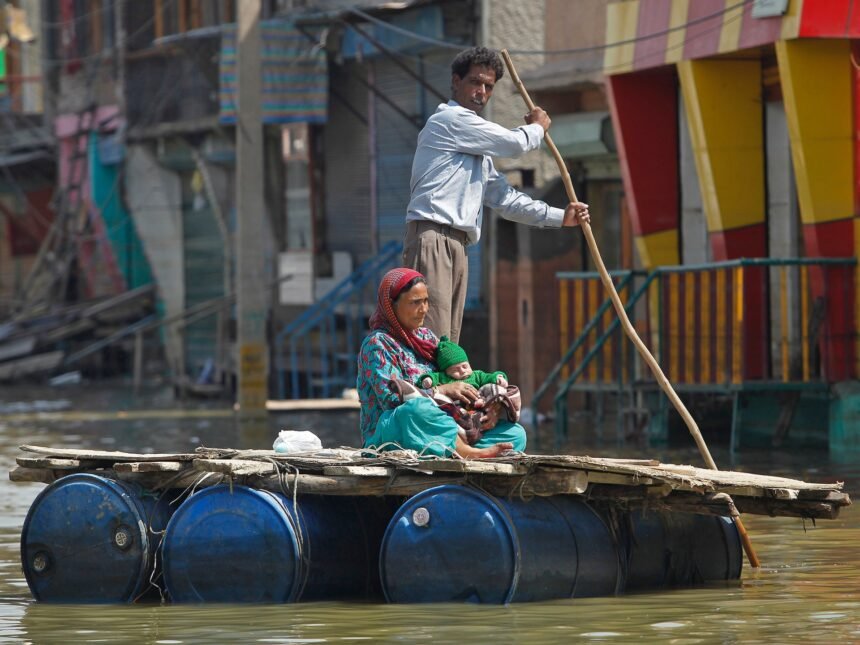
Islamabad, Pakistan – For the second time in three years, catastrophic monsoon floods have carved a path of destruction throughout Pakistan’s north and central areas, notably in its Punjab province, submerging villages, drowning farmland, displacing hundreds of thousands and killing a whole lot.
This yr, India – Pakistan’s archrival and a nuclear-armed neighbour – can be reeling. Its northern states, together with Himachal Pradesh, Uttarakhand and Indian Punjab, have seen widespread flooding as heavy monsoon rains swell rivers on each side of the border.
Advisable Tales
listing of 4 gadgetsfinish of listing
Pakistani authorities say that since late June, when the monsoon season started, at the least 884 folks have died nationally, greater than 220 of them in Punjab. On the Indian facet, the casualty rely has crossed 100, with greater than 30 lifeless in Indian Punjab.
But, shared struggling hasn’t introduced the neighbours nearer: In Pakistan’s Punjab, which borders India, federal minister Ahsan Iqbal has, in reality, accused New Delhi of intentionally releasing extra water from dams with out well timed warnings.
“India has began utilizing water as a weapon and has brought about wide-scale flooding in Punjab,” Iqbal stated final month, citing releases into the Ravi, Sutlej and Chenab rivers, all of which originate in Indian territory and circulate into Pakistan.
Iqbal additional stated that releasing flood water was the “worst instance of water aggression” by India, which he stated threatened lives, property and livelihoods.
“Some points ought to be past politics, and water cooperation have to be one in all them,” the minister stated on August 27, whereas he participated in rescue efforts in Narowal metropolis, his constituency that borders India.
These accusations come amid heightened tensions between India and Pakistan, and the breakdown of a six-decade-old pact that helped them share waters for rivers which can be lifelines to each nations.
However consultants argue that the proof is skinny to recommend that India may need intentionally sought to flood Pakistan – and the bigger nation’s personal woes level to the dangers of such a method, even when New Delhi had been to ponder it.
Weaponising water

Relations between India and Pakistan, already at a historic low, plummeted additional in April after the Pahalgam assault, during which gunmen killed 26 civilians in Indian-administered Kashmir. India blamed Pakistan for the assault and walked out of the Indus Waters Treaty (IWT), the transboundary settlement that governs the Indus Basin’s six rivers.
Pakistan rejected the accusation that it was in any manner behind the Pahalgam assault. However in early Could, the neighbours waged a four-day battle, focusing on one another’s army bases with missiles and drones within the gravest army escalation between them in virtually three many years.
Below the IWT, the 2 nations had been required to trade detailed water-flow information often. With India not adhering to the pact, fears have mounted in latest months that New Delhi may both attempt to cease the circulate of water into Pakistan, or flood its western neighbour via sudden, massive releases.
After New Delhi suspended its participation within the IWT, India’s House Minister Amit Shah in June stated the treaty would by no means be restored, a stance that prompted protests in Pakistan and accusations of “water terrorism”.
However whereas the Indian authorities has not issued a proper response to accusations that it has chosen to flood Pakistan, the Indian Excessive Fee in Islamabad has, within the final two weeks, shared a number of warnings of attainable cross-border flooding on “humanitarian grounds”.
And water consultants say that attributing Pakistan’s floods primarily to Indian water releases from dams is an “oversimplification” of the causes of the disaster that dangers obscuring the pressing, shared challenges posed by local weather change and ageing infrastructure.
“The Indian determination to launch water from their dam has not brought about flooding in Pakistan,” stated Daanish Mustafa, a professor of crucial geography at King’s Faculty London.
“India has main dams on its rivers, which ultimately make their solution to Pakistan. Any extra water that can be launched from these rivers will considerably impression India’s personal states first,” he advised Al Jazeera.
Shared monsoon pressure
Each Pakistan and India rely on glaciers within the Himalayan and Karakoram ranges to feed their rivers. For Pakistan, the Indus river basin is a lifeline. It provides water to many of the nation’s roughly 250 million folks and underpins its agriculture.

Below the IWT, India controls the three japanese rivers – Ravi, Sutlej and Beas – whereas Pakistan controls the three western rivers, Jhelum, Chenab and Indus.
India is obligated to permit waters of the western rivers to circulate into Pakistan with restricted exceptions, and to supply well timed, detailed hydrological information.
India has constructed dams on the japanese rivers it controls, and the circulate of the Ravi and Sutlej into Pakistan has significantly lowered since then. It has additionally constructed dams on a few of the western rivers – it’s allowed to, underneath the treaty, so long as that doesn’t have an effect on the amount of water flowing into Pakistan.
However melting glaciers and an unusually intense summer season monsoon pushed river ranges on each side of the border dangerously excessive this yr.
In Pakistan, glacial outbursts adopted by heavy rains raised ranges within the western rivers, whereas surging flows put infrastructure on the japanese rivers in India at critical threat.
Mustafa of King’s Faculty stated that dams – like different infrastructure – are designed conserving in thoughts a protected capability of water that they’ll maintain, and are sometimes meant to function for about 100 years. However local weather change has dramatically altered the typical rainfall that may have been taken under consideration whereas designing these tasks.
“The parameters used to construct the dams are actually out of date and meaningless,” he stated. “When the capability of the dams is exceeded, water have to be launched or it should put all the construction susceptible to destruction.”
Among the many main dams upstream in Indian territory are Salal and Baglihar on the Chenab; Pong on the Beas; Bhakra on the Sutlej; and Ranjit Sagar (also referred to as Thein) on the Ravi.
These dams are primarily based in Indian-administered Jammu and Kashmir, Indian Punjab and Himachal Pradesh, with huge areas of Indian territory between them and the border.
Blaming India for the flooding in Pakistan is unnecessary, stated Shiraz Memon, a former Pakistani consultant on the bilateral fee tasked underneath the IWT to watch the implementation of the pact.
“As a substitute of acknowledging that India has shared warnings, we’re blaming them of water terrorism. It’s [a] easy, pure flood phenomenon,” Memon stated, including that by the tip of August, reservoirs throughout the area had been full.
“With water at capability, spillways needed to be opened for downstream releases. This can be a pure resolution as there isn’t a different possibility out there,” he advised Al Jazeera.
Politics of blame

In response to September 3 information on India’s Central Water Fee web site, at the least a dozen websites face a “extreme” flood scenario, and one other 19 are above regular flood ranges.
The identical day, Pakistan’s Ministry of Water Sources issued a notification, quoting a message from the Indian Excessive Fee, warning of “excessive flood” on the Sutlej and Tawi rivers.
It was the fourth such discover by India after three earlier warnings final week, however none contained detailed hydrological information.
Pakistan’s Meteorological Division, in a report on September 4, stated on the Pakistani facet, two websites on the Sutlej and Ravi confronted “extraordinarily excessive” flood ranges, whereas two different websites on the Ravi and Chenab noticed “very excessive” ranges.
The sheer quantity of water throughout an intense monsoon typically exceeds any single dam or barrage’s capability. Managed releases have develop into a essential, if harmful, a part of flood administration on each side of the border, stated consultants.
They added that whereas the IWT obliged India to alert Pakistan to irregular flows, Pakistan additionally wants higher monitoring and real-time information programs slightly than relying solely on diplomatic exchanges.
The blame sport, analysts warn, can serve short-term political functions on each side, particularly after Could’s battle.
For India, suspending the treaty is framed as a agency stance towards what it sees as Pakistan’s state-sponsored terrorism. For Pakistan, blaming India can present a political scapegoat that distracts from home failures in flood mitigation and governance.
“Rivers live, respiration entities. That is what they do; they’re all the time on the transfer. You can not management the flood, particularly a excessive or extreme flood,” educational Mustafa stated.
Blaming India gained’t cease the floods. However, he added, it seems to be an “simple manner out to relinquish accountability”.