
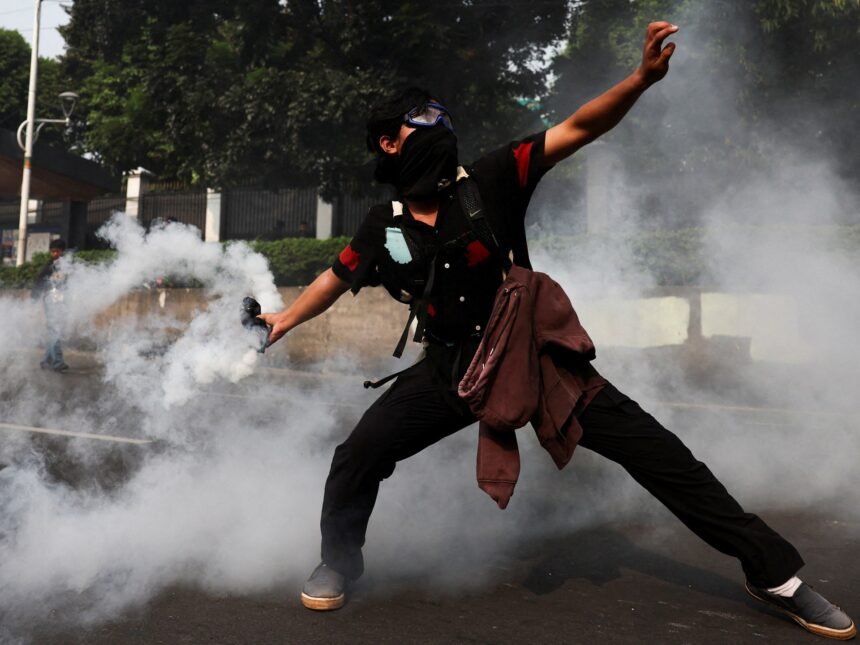
Demonstrations have gripped Indonesia since late August when anger at a faltering economic system erupted into full-blown violence following stories that politicians obtained a $3,000 housing allowance on prime of their salaries – a perk equal to between 10 and 20 instances Indonesia’s month-to-month minimal wage.
It was not the primary time that Indonesians have taken to the streets this 12 months.
Advisable Tales
listing of 4 objectsfinish of listing
In February and March, college students turned out to protest in opposition to a spread of unpopular authorities insurance policies, together with cuts to the nationwide funds and a proposed new legislation increasing the function of the navy in political affairs.
As the newest wave of protests continues to scrub over Indonesia, together with on the islands of Java, Sumatra, Sulawesi and Kalimantan, Al Jazeera spoke to 5 Indonesians* concerning the points that ignited the demonstrations and what wants to vary of their nation of greater than 283 million folks.

Loss of life of a meals supply driver
Anger peaked in late August when a bike supply driver, 21-year-old Affan Kurniawan, was run over and killed by a police car throughout protests within the capital Jakarta.
Kurniawan was reportedly not participating in demonstrations, however attempting to fulfil a meals supply order on the time of his demise.
A number of law enforcement officials are actually being investigated over his demise, and one has already been fired from his place.
Indonesia’s ubiquitous meals supply drivers are extensively seen as a logo of Indonesia’s lack of fine employment alternatives and an ever-present reminder of the nation’s poorly paid “gig-economy”, the place staff are sometimes economically exploited and socially marginalised.
Imran, a meals supply driver from Langkat in North Sumatra, informed Al Jazeera that “inequality” was the basis explanation for the mass protests which have shaken the nation.
“Together with financial inequality, academic inequality, well being inequality and unequal public providers,” Imran informed Al Jazeera.

Regardless of the financial hardships going through on a regular basis folks, the nation’s Home of Representatives nonetheless went forward and requested for a housing allowance of fifty million Indonesian rupiah per thirty days, equal to some $3,000, Imran stated.
“They aren’t involved about our destiny. They need to be current to resolve the issues going through the group, not fan the flames. These protests arose from the group’s poor financial situations,” Imran stated.
“We hope the federal government will rapidly discover a resolution to handle these points so that individuals will now not take to the streets to demand their rights,” he stated.
“We’re a part of a group that longs for peace. If our rights are fulfilled, there shall be no extra lots taking to the streets. We wish clear and clear paperwork,” he added.
Native information outlet Jakarta Globe reported on Friday that the housing allowance has been scrapped because of the demonstrations, and that the Home of Representatives had additionally selected Thursday in opposition to elevating the salaries of lawmakers and imposed a ban on their “non-essential abroad journeys”.
Financial woes
Indonesian President Prabowo Subianto, who has been in energy since October, promised on taking workplace to boost financial progress to eight % inside the subsequent 5 years.
However, the president has struggled to steadiness the books, partially because of his free lunch programme for tens of millions of schoolchildren, which is costing the federal government a reported $10bn per 12 months.
To make up for the funds shortfall, blamed partially on the free meals initiative, Prabowo’s authorities slashed state expenditures by $18bn, with the deepest cuts felt in schooling, public works and healthcare.
A outstanding Indonesian political analyst* informed Al Jazeera that many individuals really feel “disgusted” by the cuts to authorities spending, and now that Prabowo has been in energy for a 12 months, they’ve a good suggestion of “how he really governs”, in contrast with guarantees made throughout his election marketing campaign.
“Prabowo promoted himself as an financial reformer, however the emperor has no garments,” the analyst stated.

Not all is misplaced but, nevertheless, for the president.
“He nonetheless has a chance to defuse this. The federal government nonetheless has loads of room to manoeuvre to restore the harm and make concessions,” the analyst stated.
“Lots of it has to do with harm management because the protests are focused in opposition to the elite and the institution usually,” he stated, including the president may construct goodwill with the general public by holding folks to account for corruption and extreme drive in coping with protesters.
“He ought to hearth a few folks and arrest a number of folks and put them on trial. That might be one of the simplest ways to avoid wasting his presidency,” the analyst stated.
Proper to protest
Following the demise of supply driver Kurniawan, anger surged, and protesters ransacked the properties of parliamentarians and Indonesia’s Finance Minister Sri Mulyani Indrawati.
Demonstrators have been additionally blamed for setting hearth to a regional authorities nationwide meeting constructing in Makassar in Sulawesi, the place three folks have been reported killed.
As police deployed water cannon and tear gasoline to disperse crowds in cities throughout the nation, together with on college campuses, Prabowo informed the nation’s safety forces to get robust on protests that confirmed indicators of “treason and terrorism”.
Afifah, a ladies’s rights activist based mostly in Jakarta, stated there have been demonstrations for the reason that begin of the 12 months, and never simply prior to now few weeks, because of “an actual frustration about financial points in Indonesia”.
Folks have been additionally “nervous concerning the navy increasing its authority over civilians, entry to the job market and widespread poverty,” she stated.
Within the face of the demonstrations, authorities used tear gasoline, which suppressed the folks’s “proper to protest” peacefully in Indonesia, Afifah stated.

“The police must be pulled again and informed that they don’t have the proper to interrupt up demonstrations,” she informed Al Jazeera.
“We’d like widespread reform in Indonesia, and the system wants to vary. There are a variety of issues: the economic system, the setting and democracy on this nation. There must be whole reform, and it must contain all components of society, together with ladies.”
Price of dwelling disaster
Indonesia is coping with a cost-of-living disaster and inflation continues to rise, with the Financial institution of Indonesia recording a 2.31 % improve in August 2025 year-on-year.
Though the federal government stated that gross home product (GDP) grew 5.12 % within the second quarter of this 12 months, many Indonesians say these figures don’t mirror the financial scenario on the bottom, notably in rural areas.
Rahmawati, a housewife dwelling in Samarinda, East Kalimantan, stated public anger had “lastly exploded …as a result of we really feel like nobody cares about us”.
“Politicians shouldn’t care concerning the public solely once they want us, like when there are elections. Then they arrive and see us, making all these candy guarantees about how they may work on our behalf. Once they get elected, they neglect about us,” Rahmawati informed Al Jazeera.
“What we wish is for them to care about us and our wants,” she stated.
“Yearly, the worth of primary foodstuffs rises and by no means goes again down once more. Groceries have gotten increasingly troublesome to afford,” she added.
Navy issues
The present protests are a part of a wave of demonstrations that began earlier within the 12 months, together with over the passage of a controversial legislation permitting members of the navy to carry expanded authorities roles.
Since his election, former particular forces normal Prabowo, who was as soon as a son-in-law of the nation’s feared dictator Soeharto, has reportedly established dozens of recent navy battalions, with plans to create lots of extra over the subsequent 5 years.
Indonesia has a protracted historical past of repression by the armed forces, together with in Aceh Province, which fought for independence from Indonesia for greater than 30 years, leaving hundreds of Acehnese useless earlier than it turned a semi-autonomous area in 2005.
Muhammad, a social employee in Banda Aceh, the capital of Aceh, stated demonstrations had taken place there too, although the Acehnese don’t “usually reply” to Indonesian “nationwide points”.
“However, within the pursuits of solidarity, there was an illustration in entrance of the regional meeting in Banda Aceh. There was no ban on the protest by the native authorities and no riots or anarchy,” Muhammad stated.
“Our protest was a manner of airing our views with an area twist on a nationwide situation,” he stated, including {that a} reported plan by the central authorities to construct 5 new navy battalions in Aceh was a spotlight of the protests.
“We reject this, and it is extremely delicate,” he added.
“We already had 35 years of battle with the navy.”
*As a result of sensitivity of the subject material at a time of social unrest in Indonesia, interviewees requested that their names not be used or not be utilized in full.