
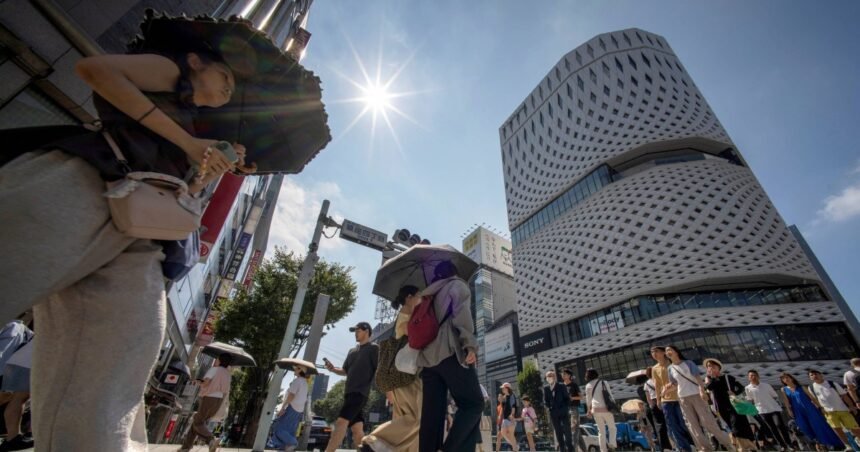
Document temperatures come amid scientists’ warnings that local weather change is inflicting extra frequent excessive climate occasions.
Revealed On 1 Sep 2025
Japan and South Korea have sweated by way of their hottest summers since data started.
Japan’s common temperature this summer time was 2.36 levels Celsius (4.24 levels Fahrenheit) above the 30-year common from 1991 to 2020, the Japan Meteorological Company (JMA) stated.
“This up to date the document as the most well liked summer time since statistics started in 1898,” the JMA stated.
Common summer time temperatures broke data at 123 out of the 153 climate stations nationwide, the climate company added, with the variety of automated meteorological stations recording “extraordinarily sizzling days” reaching a document 9,385.
The JMA stated it anticipated extreme warmth to proceed over the following two weeks, significantly in jap and western Japan, and urged residents to take acceptable precautions to keep away from heat-related diseases.
Japan final month broke the document for the most well liked day on document twice in sooner or later when temperatures within the central metropolis of Isesaki rose as excessive as 41.8C (107.24F).
In South Korea, the typical summer time temperature additionally set a brand new document, hitting 25.7C (78.26F), the very best since authorities started amassing knowledge in 1973, the Korea Meteorological Administration stated.
Each Japan and South Korea had beforehand reported 2024 as their hottest summer time on document.
South Korea’s common summer time temperature final 12 months was 25.6C (78.08F), whereas Japan’s common temperature was 1.76C (3.17F) above the norm in each 2024 and 2023.
The most recent record-setting temperatures within the East Asian nations come amid scientists’ warnings that human-driven local weather change is creating extra excessive climate.
Asia has been significantly vulnerable to excessive warmth, based on the World Meteorological Group (WMO).
In its newest local weather report launched in June, the UN physique stated the area was warming practically twice as quick as the worldwide common.
The typical temperature of Asia’s landmass final 12 months was about 1.04C (1.87F) above the 1991-2020 pattern, based on the WMO, making 2024 both the warmest or second warmest 12 months on document, relying on the dataset used.