
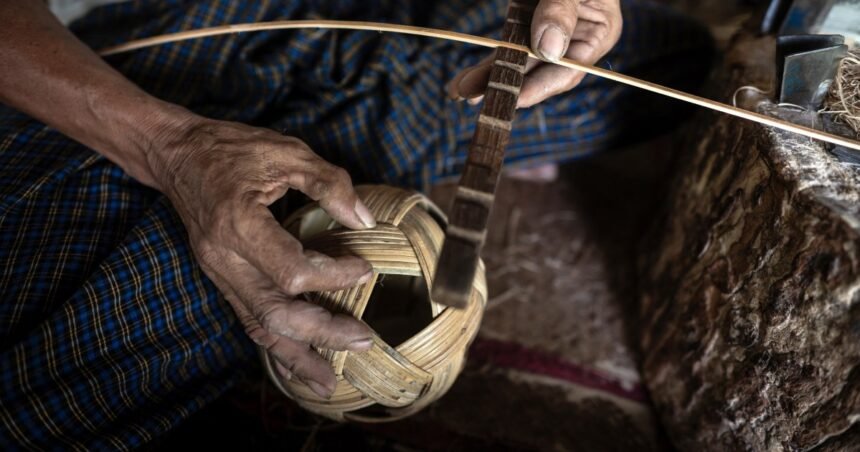
Mastering management of the ever rising and falling rattan chinlone ball instils endurance, a veteran of Myanmar’s conventional sport says.
“When you get into taking part in the sport, you overlook every thing,” 74-year-old Win Tint says.
“You focus solely in your contact, and also you focus solely in your model.”
Chinlone, Myanmar’s nationwide recreation, traces its roots again centuries. Described as a fusion of sport and artwork, it’s usually accompanied by music and sometimes sees women and men taking part in in distinct methods.
Groups of males type a circle, passing the ball amongst themselves utilizing stylised actions of their toes, knees and heads in a recreation of “keepy-uppy” with a scoring system that is still inscrutable to outsiders.
Ladies, in the meantime, play solo in a vogue harking back to circus acts – kicking the ball tens of hundreds of instances per session whereas strolling tightropes, spinning umbrellas and balancing on chairs positioned atop beer bottles.
Participation has declined in recent times with the onset of the COVID-19 pandemic, adopted by the 2021 army coup and subsequent civil battle.
Poverty is on the rise, and artisans face mounting challenges in sourcing supplies to craft the balls.
Variants of the hands-free sport, colloquially often known as caneball, are performed extensively throughout Southeast Asia.
In Thailand, Malaysia and Indonesia, members use their toes and heads to ship the ball over a web within the volleyball-style recreation “sepak takraw”.
In Laos, it is named “kataw” whereas Filipinos play “sipa”, which means kick.
In China, it is not uncommon to see individuals kicking weighted shuttlecocks in parks.
Myanmar’s model is believed up to now again 1,500 years.
Proof for its longevity is seen in a French archaeologist’s discovery of a duplicate silver chinlone ball at a pagoda constructed throughout the Pyu period, which stretched from 200 BC to 900 AD.
Initially, the game was performed as an informal pastime, a type of train and for royal amusement.
In 1953, nonetheless, the sport was codified with formal guidelines and a scoring system, a part of efforts to outline Myanmar’s nationwide tradition after independence from Britain.
“Nobody else will protect Myanmar’s conventional heritage until the Myanmar individuals do it,” participant Min Naing, 42, says.
Regardless of ongoing battle, gamers proceed to congregate beneath motorway flyovers, round avenue lamps dimmed by wartime blackouts and on purpose-made chinlone courts – usually open-sided steel sheds with concrete flooring.
“I fear about this sport disappearing,” grasp chinlone ball maker Pe Thein says whereas labouring in a sweltering workshop in Hinthada, 110km (68 miles) northwest of Yangon.
“That’s the rationale we’re passing it on by our handiwork.”
Seated cross-legged, males shave cane into strips, curve them with a hand crank and deftly weave them into melon-sized balls with pentagonal holes earlier than boiling them in vats of water to reinforce their sturdiness.
“We examine our chinlone’s high quality as if we’re checking diamonds or gems,” the 64-year-old Pe Thein says.
“As we respect the chinlone, it respects us again.”
Every ball takes about two hours to supply and brings business-owner Maung Kaw $2.40.
However provides of the premium rattan he seeks from Rakhine state in western Myanmar have gotten scarce.
Fierce preventing between army forces and opposition teams that now management almost all the state has made provides precarious.
Farmers are too frightened to enterprise into the jungle battlegrounds to chop cane, Maung Kaw says, which jeopardises his livelihood.