
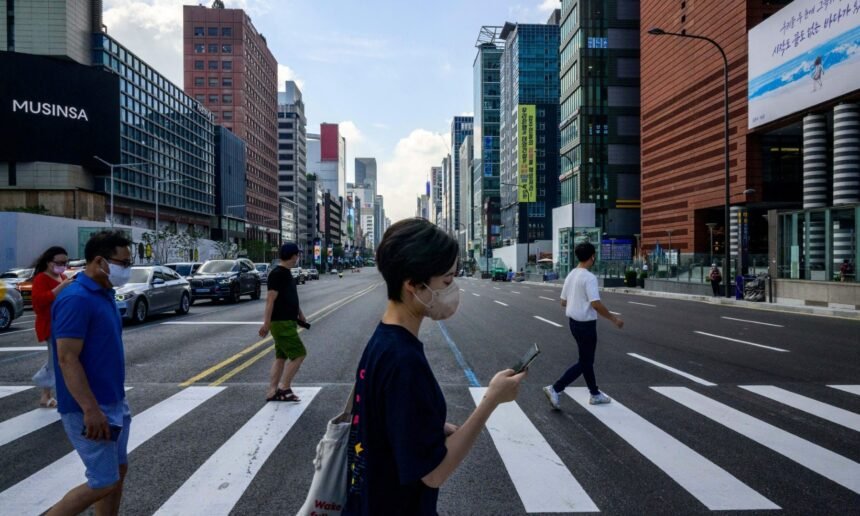
Seoul, South Korea – Go Kyoung-min, 34, a nurse at Severance Hospital in Seoul, discovered a brand new sense of steadiness in her life in the course of the first half of this yr.
Because the mom of dual daughters born in 2021, Go typically felt responsible about not spending sufficient time together with her kids due to work.
Really helpful Tales
record of 4 gadgetsfinish of record
However after opting into the four-day workweek provided by her office, Go was in a position to spend extra time together with her household, attending daycare occasions she had beforehand missed and relying much less on her in-laws for childcare.
Severance is the primary hospital in South Korea to trial a four-day workweek, aiming to enhance the work-life steadiness of its employees.
Underneath this system, launched in 2023 following an settlement between labour and administration, some hospital staff are allowed to take three days off per week in change for a ten p.c discount in wage.
Employees take turns collaborating in six-month rotations, after which they return to a five-day week.
This system seems to have improved nurses’ well being and wellbeing, enhanced the standard of medical companies, boosted organisational effectivity, and diminished turnover charges, the Korea Employee Institute-Union Heart mentioned in a report concerning the trial launched final month.
In line with the report, turnover amongst collaborating nurses with lower than three years’ expertise fell from 19.5 p.c to 7 p.c.
Common sick go away per worker additionally fell by at some point in the course of the trial, whereas it elevated by 0.7 days in wards on five-day weeks.
Go mentioned the four-day workweek not solely improved her work-life steadiness however helped her be extra centered and kinder to her sufferers.
“I work within the pancreatobiliary ward, the place many sufferers face important conditions. This makes the workload heavier. With a four-day workweek, I really feel I can take extra time to take heed to sufferers and take care of them with higher duty,” she informed Al Jazeera.
“My kids was once completely happy when their grandparents picked them up from daycare, taking it with no consideration. However as soon as I did it extra typically, they anticipated me to be there.”

Go’s expertise is uncommon in South Korea, a rustic infamous for its lengthy working hours, the place staying late is usually seen as a mark of a great worker.
South Korean staff logged a median of 1,865 hours in 2024, based on the Organisation for Financial Co-operation and Improvement (OECD), the sixth-highest amongst developed international locations and properly above the OECD common of 1,736 hours.
They labored 248 hours greater than their counterparts in neighbouring Japan.
Whereas lengthy workdays are nonetheless the norm, shorter work preparations are step by step spreading within the personal sector.
Some corporations, notably IT companies and startups, have been experimenting with four-day or four-and-a-half-day workweeks for a number of years.
South Korea’s main conglomerates have additionally proven curiosity in additional versatile work preparations, with Samsung Electronics, SK Group, and Kakao introducing programmes providing staff periodic breaks of a full or half-day.
Lee Jae-ho, 42, a father of two who works at sports activities and well being expertise firm Kakao VX, has benefitted from one such program, getting one Friday off every month and dealing 1.5 hours much less on the remaining Fridays.
Lee mentioned working fewer days doesn’t essentially scale back effectivity.
“When I’ve a Friday off or shorter hours, I modify my schedule upfront, so the diminished workdays have little impression on productiveness,” Lee informed Al Jazeera.
“I’ve extra time to have dinner with my household, recharge, and pursue my hobbies and development.”
The push to reform South Korea’s work tradition has gained momentum for the reason that election of left-leaning President Lee Jae-myung in June.
Throughout his marketing campaign, Lee pledged to chop working hours under the OECD common by 2030 and introduce a four-and-a-half-day workweek.
At a July information convention, Lee reiterated that South Koreans wanted to work much less, suggesting {that a} system of lengthy hours with low productiveness was unsustainable.
“We’ve got competed extra on amount than on high quality,” Lee mentioned.

Cafe24, South Korea’s main e-commerce options supplier, carried out a full four-day workweek in July, after beforehand providing staff each different Friday off, whereas sustaining staff’ salaries and total hours.
In June, Gyeonggi Province, which surrounds Seoul, launched the nation’s first pilot venture of a four-and-a-half-day workweek with out wage cuts amongst native governments, set to run till 2027.
The programme, operating till 2027, encourages small and midsize companies and public establishments within the province to experiment with diminished working hours by offering monetary help to cowl the elevated labour prices.
Some specialists and enterprise leaders have expressed issues concerning the strikes to chop the working week.
Kwon Younger-sik, director of human sources at Yonsei College Well being System, the mum or dad organisation of Severance, has mentioned completely shifting to a four-day workweek would value about 100 million received ($720) per ward in labour prices alone.
“Over the previous three years, about 1.2 billion received has been spent on labour prices,” Kwon mentioned final month at an occasion the place Severance’s labour union offered the outcomes of the pilot programme.

On the identical occasion, Lee Kang-young, basic director of Severance, mentioned institutional and monetary help can be “completely vital” for a four-day workweek to be sustainable.
Park Nam-gyoo, a enterprise professor at Seoul Nationwide College, mentioned he can be involved about productiveness and disparities within the labour market if a four-and-a-half-day workweek grew to become the norm.
“South Korea is an export-led economic system. It faces an unsure future if it fails to stay aggressive globally,” Park informed Al Jazeera.
He mentioned the nation wanted to contemplate its low birthrate, sluggish economic system, and challenges to its international competitiveness.
However staff like Go and Lee hope extra folks can expertise the advantages they’ve loved.
“There have been completely no drawbacks. The one draw back in my case was that, as it’s a pilot programme, just a few might take part, so I really feel sorry for my colleagues who couldn’t. Apart from that, it ran easily with none operational points,” Go mentioned.
“Simply because the five-day workweek was initially met with concern however ultimately settled in, a four-day workweek is anticipated to step by step carry optimistic modifications to society,” Lee mentioned.