
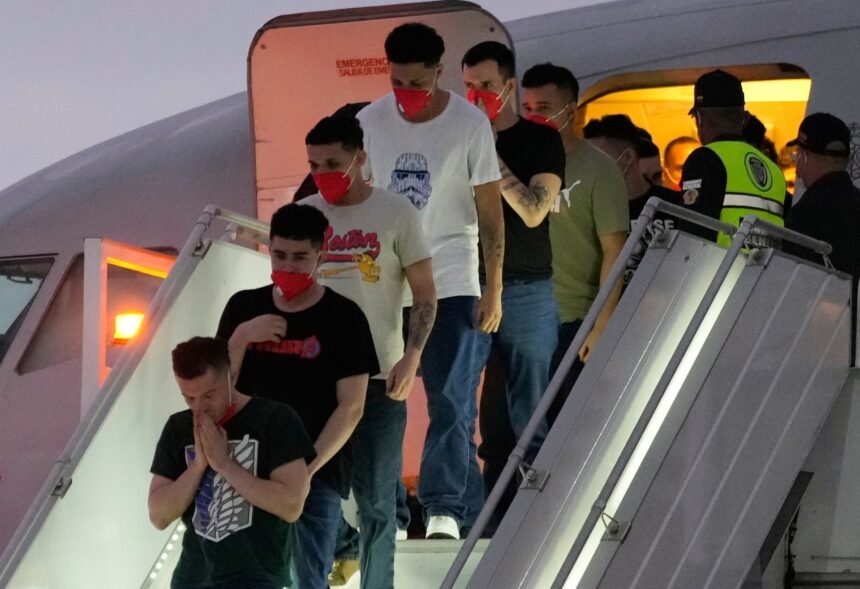
A federal appeals courtroom has dominated that the administration of United States President Donald Trump illegally invoked a wartime regulation to deport Venezuelans as a part of its immigration crackdown.
Late on Tuesday, a majority on the Fifth Circuit Courtroom of Appeals rejected Trump’s use of the Alien Enemies Act of 1798 to expedite deportations with out due course of.
The choice was outstanding on a number of fronts. It was the primary time a federal appellate courtroom had weighed Trump’s use of the 18th-century regulation, but it surely was additionally a powerful rebuke to Trump’s mass deportation marketing campaign from a courtroom with a popularity for leaning conservative.
Writing for almost all on the three-person bench, Choose Leslie Southwick rejected Trump’s declare that the Venezuelan gang Tren de Aragua represented an invasion into the US.
“We conclude that the findings don’t help that an invasion or a predatory incursion has occurred,” Southwick wrote.
“We due to this fact conclude that petitioners are more likely to show that the AEA [Alien Enemies Act] was improperly invoked.”
The Alien Enemies Act has the ability to provide the federal government wide-ranging powers to detain and deport residents of “hostile” international nations, however solely in occasions of struggle or throughout an “invasion or predatory incursion”.
Earlier than Trump, the regulation had solely been used 3 times — and completely throughout struggle. However Trump officers have used the regulation to justify the speedy deportation of Venezuelan migrants, on the idea that they represent a felony “invasion” throughout the border.
Southwick, who was appointed by Republican President George W Bush, rejected that argument.
“There is no such thing as a discovering that this mass immigration was an armed, organized pressure or forces,” Southwick wrote.
The panel is the best federal courtroom to thus far rule on Trump’s makes an attempt to make use of the regulation for deportations. The case is anticipated to ultimately make its method to the US Supreme Courtroom.
Tuesday’s ruling, nevertheless, was restricted in scope: It solely applies to states underneath the appeals courtroom’s jurisdiction — Texas, Louisiana and Mississippi — although it could possibly be cited as a precedent in different appeals courtroom circuits.
Trump first invoked the Alien Enemies Act on March 15, publishing an government order that accused the Tren de Aragua gang of “perpetrating, trying, and threatening an invasion or predatory incursion” into the US.
That very same day, his administration flew two planeloads of Venezuelan migrants to El Salvador’s Terrorism Confinement Centre (CECOT), a maximum-security jail infamous for human rights abuses.
That got here regardless of a decrease decide’s order blocking his use of the regulation whereas the flights had been underneath approach.
Trump officers accused the Venezuelan migrants on these flights of being Tren de Aragua members, although their attorneys level out that a lot of them had no felony data.
To satisfy the requirements for utilizing the Alien Enemies Act, the Trump administration has repeatedly claimed that Tren de Aragua is managed by Venezuelan President Nicolas Maduro, a longtime rival of the Republican chief.
Trump has accused Maduro of masterminding a “narco-terrorism enterprise” in a coordinated effort to destabilise the US. However a declassified US intelligence memo has contradicted this declare, saying there isn’t a proof that Maduro coordinated with Tren de Aragua.
On Tuesday, the US introduced it had attacked a ship carrying 11 alleged Tren de Aragua members in worldwide waters within the Caribbean, killing all on board. Trump claimed they had been “narcoterrorists”.
Circumstances associated to Trump’s use of the Alien Enemies Act have twice reached the US Supreme Courtroom, which has not but addressed the underlying validity of the Trump administration’s actions.
In April, the Supreme Courtroom dominated that deportations underneath the act may proceed, however that immigrants ought to have “cheap time” to contest their removals.
It additionally determined that such challenges must be introduced within the federal districts the place the deportees are being held, versus courts elsewhere within the nation.
In a second ruling, additionally in April, the Supreme Courtroom blocked the deportations of a gaggle of Venezuelan males in northern Texas.
Then, in Might, the Supreme Courtroom prolonged the block, faulting the Trump administration for trying to swiftly take away detainees simply sooner or later after offering them with deportation notices.
“Discover roughly 24 hours earlier than elimination, devoid of details about easy methods to train due course of rights to contest that elimination, certainly doesn’t move muster,” the majority opinion stated.
The case was in the end despatched again to the Fifth Circuit Courtroom of Appeals.
In an announcement after Tuesday’s choice, Lee Gelernt, a lawyer for the American Civil Liberties Union (ACLU), referred to as the ruling a “critically necessary choice reining within the administration’s view that it may well merely declare an emergency with none oversight by the courts”.
The ACLU represented the Venezuelan males within the case.
However there was one decide who dissented from Tuesday’s choice on the Fifth Circuit Courtroom: Andrew Oldham, a Trump appointee.
Oldham argued that deportations underneath the Alien Enemies Act had been “issues of political judgment” and that the president has the fitting to find out whether or not the suitable situations had been met.
“From the daybreak of our nation till President Trump took workplace a second time, courts have by no means second-guessed the President’s invocation of that Act,” Oldham wrote.